ShareDev Technologies designs and develops custom software around the way a business actually operates. We help organizations replace disconnected processes, connect existing systems, modernize older applications, and create software that supports employees and customers.

That usually starts with a process someone is holding together by hand - a spreadsheet everyone edits, information re-typed between two systems, or a job that only works because one person remembers the steps.
What We Build

The common thread is business systems that have to be reliable and have to fit a specific organization.

Applications and Portals

Internal business applications, workflow and operations software, and portals that give customers or employees a place to do what they need without going through someone else.

Data and Reporting

SQL Server databases and reporting, data import and export processes, and ETL work so the numbers people make decisions on are correct and current.

Modernization

Older applications that still do a necessary job but are increasingly hard to maintain, brought forward without throwing away what already works.

  • Internal Business Applications
  • Customer & Employee Portals
  • Workflow & Operations Software
  • Web Applications
  • Mobile Applications
  • APIs & System Integrations
  • Database-Driven Applications
  • SQL Server & Reporting
  • Data Import & Export
  • ETL & Data Processing
  • Legacy Modernization
  • AI-Enabled Features
  • Ongoing Enhancements & Support

Integrations and Data

Custom software does not always mean replacing everything. Often the systems you have are fine and the problem is that they do not talk to each other.

Connect what you already own

REST APIs, SQL Server, scheduled data imports and exports, and custom integration services between existing line-of-business platforms. The goal is removing the manual step in the middle, not starting over.

Extend rather than replace

Sometimes a system does 80 percent of what you need. Adding the missing piece alongside it is usually faster, cheaper and less disruptive than replacing a platform your team already knows.

Buy, Integrate, Modernize, or Build

Not every problem needs new custom software. Working out which of these four it is comes first.

Buy

If an existing product already does the job, buying and configuring it properly is the cheaper answer. We will say so.

Integrate

If the tools are right but disconnected, connecting them solves the problem at a fraction of the cost of building.

Modernize

If something works but is aging, improving it is often better than a rewrite that reintroduces solved problems.

Build

When the process is genuinely specific to your business and nothing off the shelf fits, building is worth it.

We would rather tell you the problem can be solved without a custom build than sell you one you did not need.

Our Software Development Process

  1. Understand the business problem. What is actually slowing things down, in your terms.
  2. Define requirements and priorities. What matters first, and what can wait.
  3. Select the right architecture. Including deciding whether to build at all.
  4. Design the user experience and data model. How people use it, and how the data is structured underneath.
  5. Develop and integrate. Building it and connecting it to the systems it needs.
  6. Test and prepare for deployment. Verified before it goes anywhere near production.
  7. Support and improve over time. Software is not finished at launch.

Technology We Work In

Listed so you know what you would be getting, not as a checklist. The right choice depends on the problem.

  • .NET & ASP.NET Core
  • Razor Pages
  • Blazor where interactivity warrants it
  • Mobile Applications
  • SQL Server & Data Architecture
  • REST APIs & Integrations
  • Azure & IIS Deployment

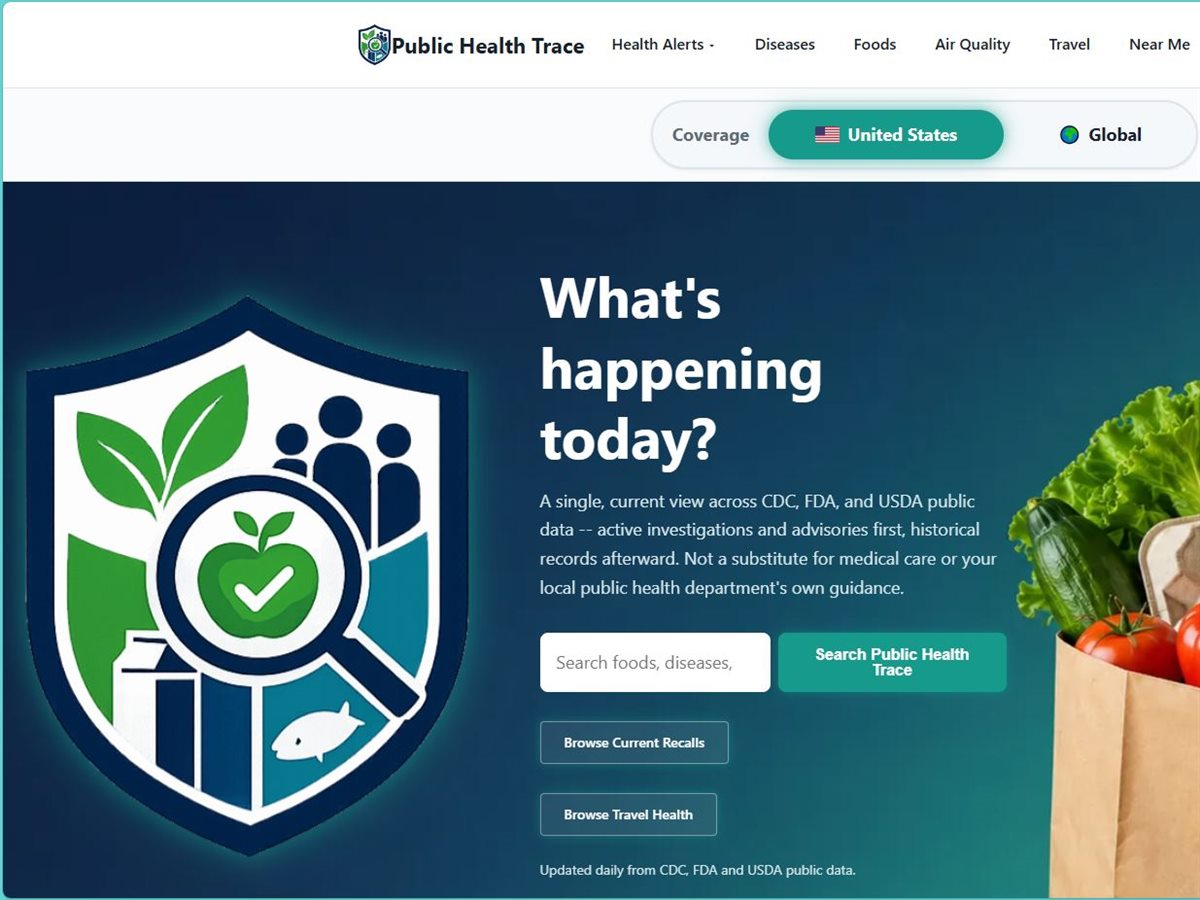
A Worked Example: Public Health Trace

One of our own products, and a working demonstration of the data and integration work described above.

Public Health Trace is an independent public information platform that brings food and drug recalls, outbreaks, disease surveillance and air-quality information from official sources such as the CDC, FDA, USDA and EPA into one searchable experience. Visitors can explore current health alerts, browse information by state, search connected public datasets and subscribe to free alerts.

The engineering problem is the one a lot of businesses have in a smaller form: useful information exists, but it is scattered across separate sources that publish in different formats on different schedules, and none of them were designed to be read together.

  • Public-Facing Web Application
  • Multi-Source Data Collection
  • Data Normalization
  • Search & Filtering
  • Connected Records
  • State-Specific Views
  • CSV Exports
  • Email Alert Subscriptions
  • Scheduled Data Updates
  • Source Attribution & Traceability

Visit Public Health Trace

Public Health Trace is an independent information service. It is not affiliated with, endorsed by or operated by the CDC, FDA, USDA, EPA or any other government agency. It presents information from official public sources and links records back to those sources. It is not a source of medical advice, and it does not use AI to invent or rewrite public-health facts.

Software We've Built

ShareDev designs, builds and operates its own software products - mobile apps, an AI platform, integrations with payment and point-of-sale systems, and published games. That is the same team and the same standards you would get on your project.

Our founders also spent their careers building systems at other companies before ShareDev, including call centre automation, healthcare billing platforms, lottery terminals and enterprise data architecture. That history is listed in full on Our Work, kept clearly separate from ShareDev's own client projects - those companies were employers, not ShareDev clients.

Connect